


gazin.project.headline


Introduction
Dengbêjs and the oral cultural forms they perform were once an organic element of cultural life, especially in rural Kurdish society. Political pressures and global cultural changes gradually led to the decline of this performance tradition in the second half of the twentieth century. However, since the late 1980s and early 1990s, when the Kurdish nation-building process took on a predominantly cultural character, dengbêjs and the performance tradition known as dengbêjî have gained a more central position in Kurdish culture than ever before. The last 20 to 30 years have also witnessed a major reconsideration of the social and national significance and role of dengbêjs, as well as the national and linguistic dimensions and functions of the genres they perform.
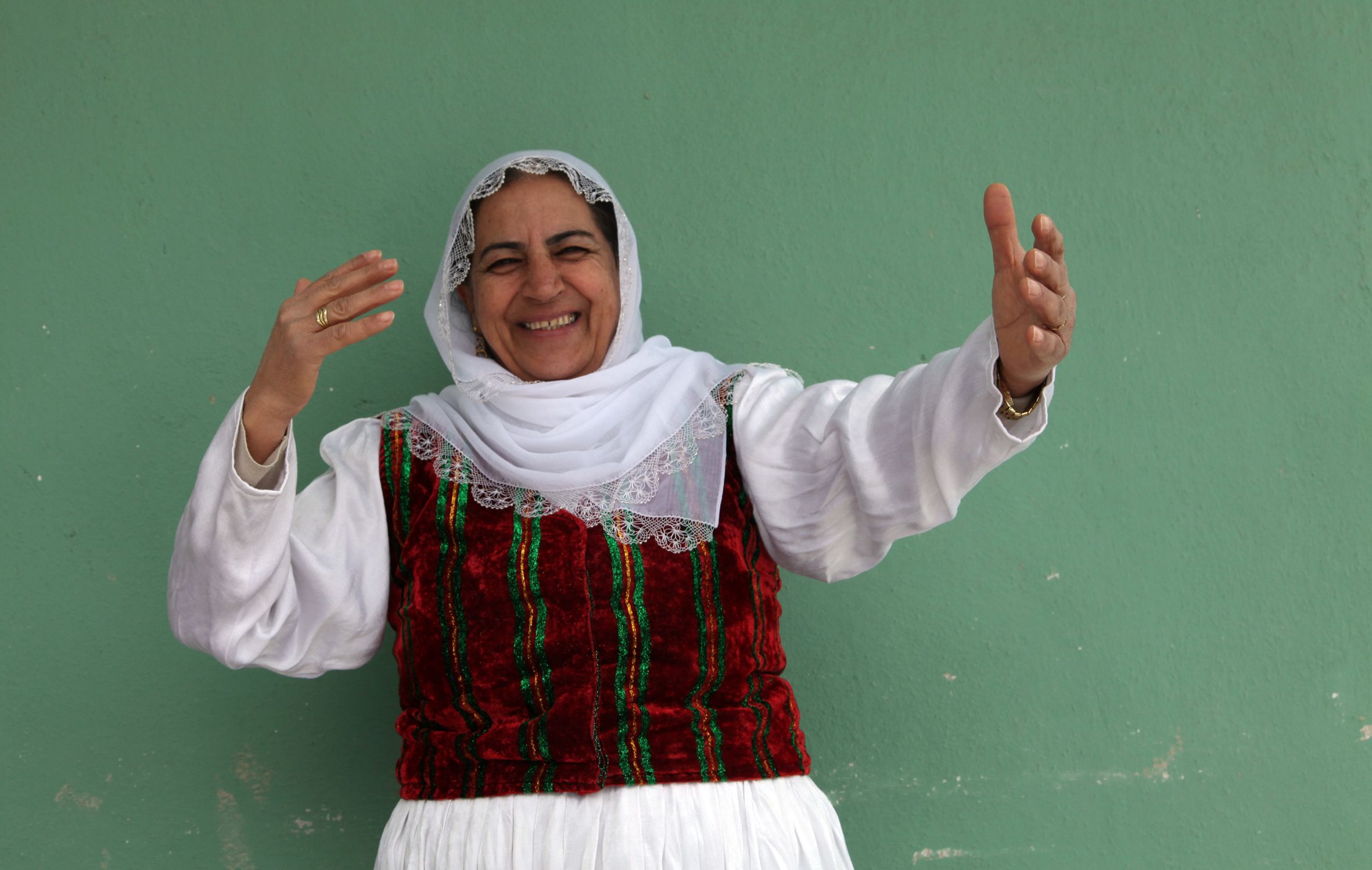
In this process, female dengbêjs, whose voices had been marginalized and silenced due to general taboos surrounding women’s presence in public spaces and their public performance in musical contexts, in particular, have come noticeably to the forefront. The late Gazîn was one of the most prominent female dengbêjs following the 1990s. This edition provides a rich resource documenting Gazîn’s repertoire and performance practices, containing some of her own works as well as many unpublished renditions of traditional govend (circle dance) songs and kilams (non-metered narrative songs) from various regions as performed by her.
Being one of the few editions that compile the works of a female dengbêj, the current edition of Dengbêj Gazîn’s works offers a unique and immensely valuable data set for the study of Kurdish oral culture. Although it is yet to be determined to what extent her repertoire is typical for female performers, we can observe that Gazîn performed fewer kilams focused on heroism and historical events compared to male dengbêjs. Instead, her repertoire contains more kilams with tragic love themes, as well as govend songs with a distinct female perspective and voice. Further research is needed to determine whether this tendency, also observed in other regions (for example, in Dersim), is characteristic of female dengbêjs or women performers in general.
The recordings that make up this edition consist of a selection of 210 works, which I selected from over 500 recordings found on Gazîn’s two personal audio recorders, as well as their Kurdish transcriptions and Turkish translations. The main criteria for the selection were intelligibility, which is largely dependent on audio quality, and a minimum level of completeness. These recordings are not »finished« works, however. In some cases we witness Gazîn practicing a piece; in others, we observe the process of how a piece is created through repeated attempts. Gazîn might forget a line or a word, change a word or expression she doesn’t like on the spot, or repeatedly use a word that does not fit in terms of meaning without feeling the need to correct it. In this respect, this edition offers a unique resource that would be difficult to obtain under normal circumstances, providing us with a window into Gazîn’s personal creative process.
About the Edition
This edition contains audio recordings and their Kurdish transcriptions, as well as Turkish translations for most of them. The main contribution to the transcriptions came from Rêbîn Özmen, who transcribed the vast majority of the audio recordings. I then reviewed and corrected these texts and formatted them to fit the edition. While I take full responsibility for the Turkish translations, Rêbîn Özmen provided great assistance with determining the meaning of various words and expressions I was uncertain about. For the Kurdish transcriptions, Lokman Turgut generously offered his extensive knowledge of Kurdish and provided invaluable support, especially concerning parts I was unable to resolve myself. I am deeply grateful to Rêbîn and Lokman for all their help.
Two individuals played a crucial role in the realization of this edition. Anthropologist Marlene Schäfers, a close friend of the late Gazîn and her family, facilitated the transfer of the audio recordings to the Orient-Institut Istanbul. Ethnomusicologist Martin Greve ensured that this edition was institutionally taken on as a project and prepared for publication. I extend my heartfelt thanks to both of them for their significant efforts and for entrusting me with the responsibility of this edition.
Argun Çakır